
Field Lane Primary School

Active Travel
We have a well-established group of student Active Travel Inspectors and strongly encourage students to travel to school by walking, cycling or using the bus, where possible. This is much better for the environment, reduces pollution for students who are walking and helps to reduce traffic congestion around the entrances to school.
An awareness of travelling actively is integral to Field Lane School’s overriding sustainability concept.
Our school promotes walking, wheeling and cycling because…
- It helps keep ur students fitter and healthy, plus research shows being active can help students concentrate better and increase their levels of achievement.
By walking or cycling, our school community can help reduce the number of vehicles on the road, making it safer for pedestrians and cyclists and easier for local residents. It also creates cleaner air by reducing the pollution caused by exhaust fumes and helps combat climate change.
Five Reasons to walk, wheel or cycle your journey to school:
- Catch up with friends
- It’s good for the planet
- Boosts brain power
- Maintains a healthy lifestyle
- To be street savvy and safe
Park and Stride
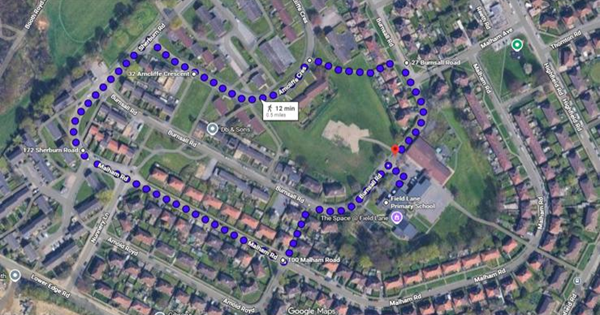
Park and Stride is a simple idea for those who live further away from school and usually drive, but want to enjoy the benefits of walking.
- What are the benefits of Park and Stride?
- Research shows that children who walk to school arrive more alert and have higher concentration levels than those who are driven. It also provides gentle exercise, and an opportunity to catch up with friends and is better for the planet!
- How can I Park and Stride?
Find a suitable parking space within walking distance of the school and get going on your walk to school. You can even consult our walking bubble map to find the best route to walk.
Cycling to school
The school has a bike and scooter shelter where staff and pupils can store their bikes throughout the school day.
Have a look at the route planner below to find the best routes to cycle to school.
The Best Route Planner for Cycling, Walking, Hiking and Running | Komoot
Please can we remind our pupils about helmet wearing, following cycle training and being bright and seen, especially in the dark.
Travelling by car
If our pupils and families travel via car to school, we politely ask drivers not to idle while waiting in order to improve air quality.
What is idling?
- Idling means leaving a vehicle's engine running while it is stationary.
Why is idling bad?
- It increases the amount of exhaust emissions in the air, which can be harmful to both the environment and health, causing asthma and other lung diseases – especially dangerous for school children whose lungs are still developing.
What does the law say about idling?
- Rule 123 of The Highway Code is ‘The Driver and the Environment’. It states that drivers must not leave a parked vehicle unattended with the engine running or leave the engine running unnecessarily while the vehicle is stationary on a public road. Doing so may lead to a £20 fine which Local Authorities have the power to give.
How can we avoid idling?
- When stuck in traffic, most modern vehicles have ‘stop-start’ systems which automatically switch the engine off when the vehicle is stationary and restart it when the accelerator is pressed. For vehicles without it, it’s fine to turn off the engine but try to avoid doing it repeatedly.
- Outside school gates and when stationary, turning off your engine is a no-brainer to protect the health of school children.